Table recognition models keep improving. As of October 7, 2026, TeleOCR is a strong candidate if you choose by OmniDocBench table recognition scores.
Which benchmark should we look at?
OmniDocBench evaluates document parsing, including table recognition. For tables, two useful columns are Table TEDS and Table TEDS-S, also called TEDS-Structure. Both reward higher similarity to the reference table.
What are Table TEDS and TEDS-Structure?
TEDS stands for Tree-Edit-Distance-based Similarity. It compares the predicted table and the reference table as HTML trees, checking rows, cells, merged-cell spans, and cell text. Insertions, deletions, and substitutions reduce the score. Similarity is normalized to a scale from 0 to 1, often displayed from 0 to 100 on leaderboards.
TEDS-Structure uses the same comparison while ignoring cell text. It measures whether the table's organization is correct, including row and column spans, without penalizing OCR mistakes in the cell contents.
For example, a model might recover every row, column, and merged header but read 1,250 as 1,280. Its structure-only score can still be perfect, while its full TEDS score drops. If it incorrectly splits a merged header into separate cells, both scores can drop.
The Benchmark Comparison
The benchmark project's published OmniDocBench v1.6_full comparison lists these results, checked on October 7, 2026:
| Model | Size | Table TEDS ↑ | Table TEDS-Structure ↑ |
|---|---|---|---|
| TeleOCR | 1.2B | 96.8183 | 98.1806 |
| PaddleOCR-VL-1.6 | 0.9B | 94.7619 | 97.1002 |
| OvisOCR2 | 0.8B | 94.5842 | 96.9768 |
| MinerU2.5-Pro | 1.2B | 93.42 | 95.92 |
| GLM-OCR | 0.9B | 92.83 | 95.39 |
| Unlimited-OCR | 3B | 90.21 | 93.3565 |
| HunyuanOCR-1.5 | 1B | 91.01 | 93.23 |
Source: OmniDocBench's end-to-end evaluation results. TeleOCR leads both table columns in that published comparison.
Where benchmarks fall short
Benchmarks make comparisons useful, but a leaderboard leaves several practical questions unanswered:
- Your tables may look different. A model that handles clean document pages well may struggle with your phone photos, faint borders, unusual headers, or specialized notation. Test examples that match your actual inputs.
- Accuracy is only part of the decision. Table similarity scores do not tell you the latency, memory requirements, operating cost, privacy implications, or quality of the final Excel export.
These are practical reasons to use benchmark results as a shortlist, then run a small evaluation on your own documents. There is no single score that captures every requirement of a table extraction workflow.
TeleOCR's strengths
Beyond its benchmark scores, TeleOCR has several useful features for table and document recognition:
- Parsing distorted photos directly. Its geometry-aware document modeling handles curved or warped pages without a separate dewarping step. Curvature-Guided Douglas-Peucker Sampling helps represent irregular document boundaries. This supports recognition from photographed pages.
- One model for digital documents and photos. TeleOCR is designed for both clean digital pages and camera-captured documents, making it a candidate for workflows that receive mixed input types.
- Separate learning of content and structure. Its content-structure decoupled learning targets tables and formulas, addressing both what a cell contains and how the table is organized.
These features are described in the official TeleOCR model card
This model is available in image-to-table, choose the Accurate mode.
A table TeleOCR recognizes correctly but HunyuanOCR-1.5 misses
The table below comes from the Fast Retailing FY2026 Q4 financial report. It has an unusual layout with a distinctly Japanese style.
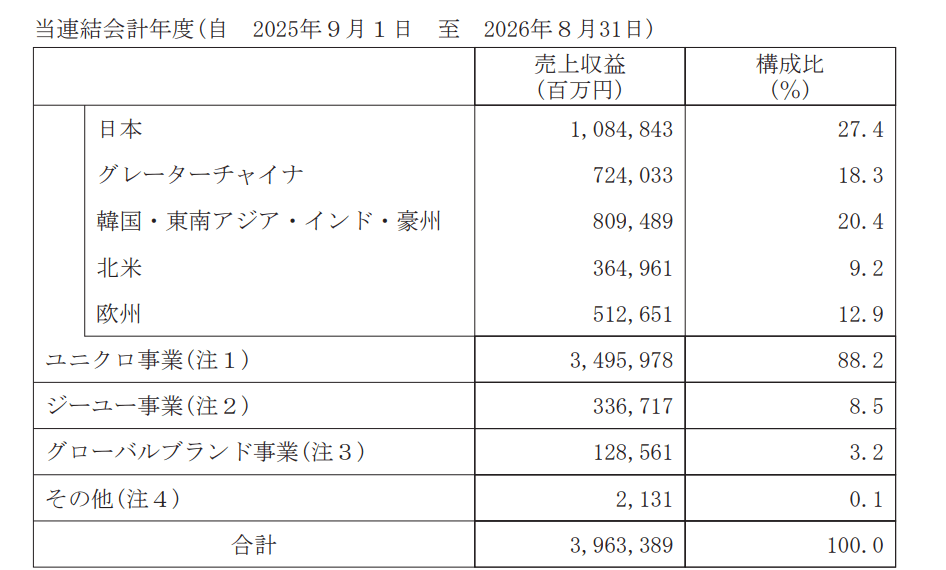
HunyuanOCR-1.5 omits one column from the table.
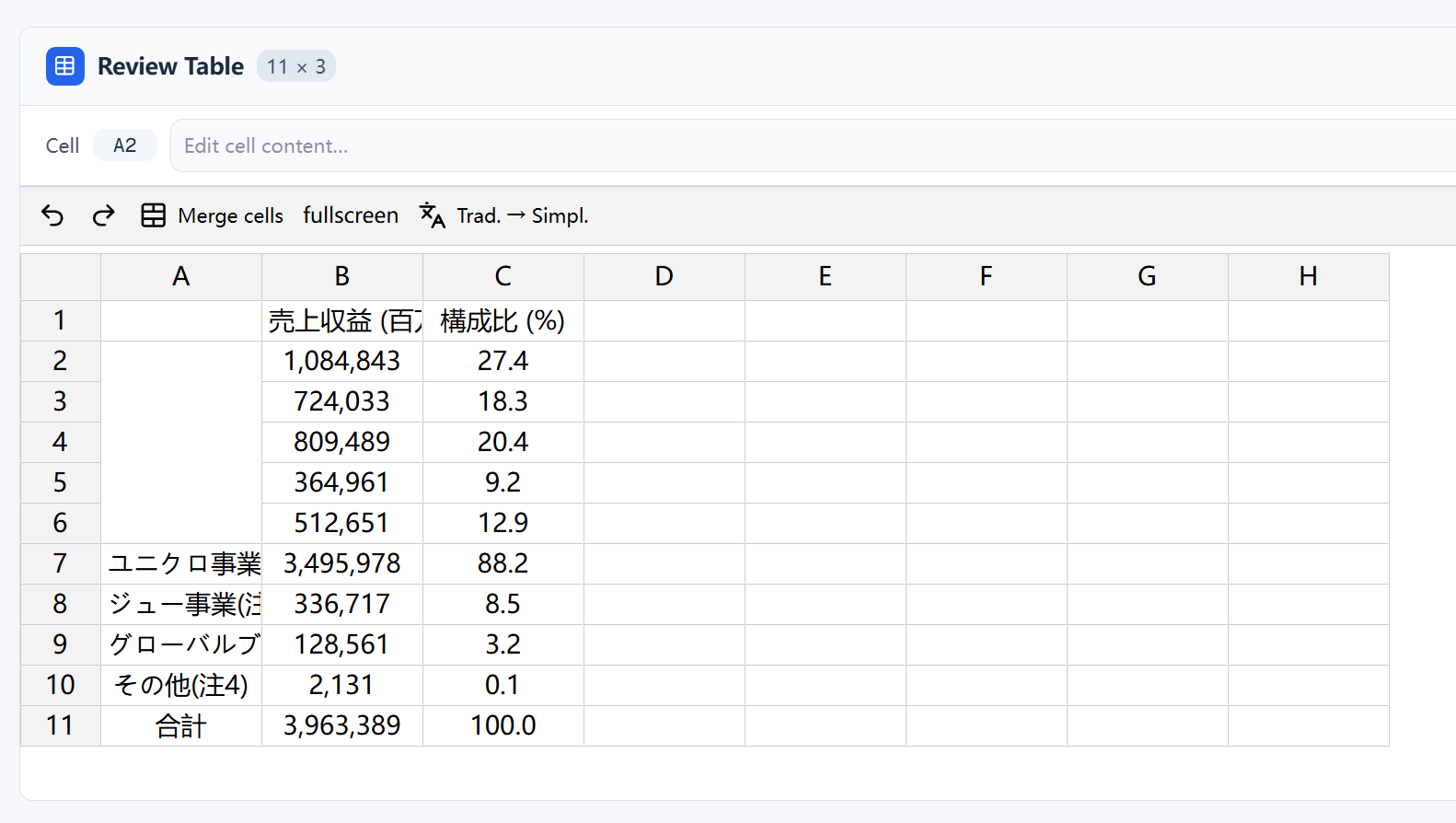
TeleOCR correctly preserves all columns and the table's structure.
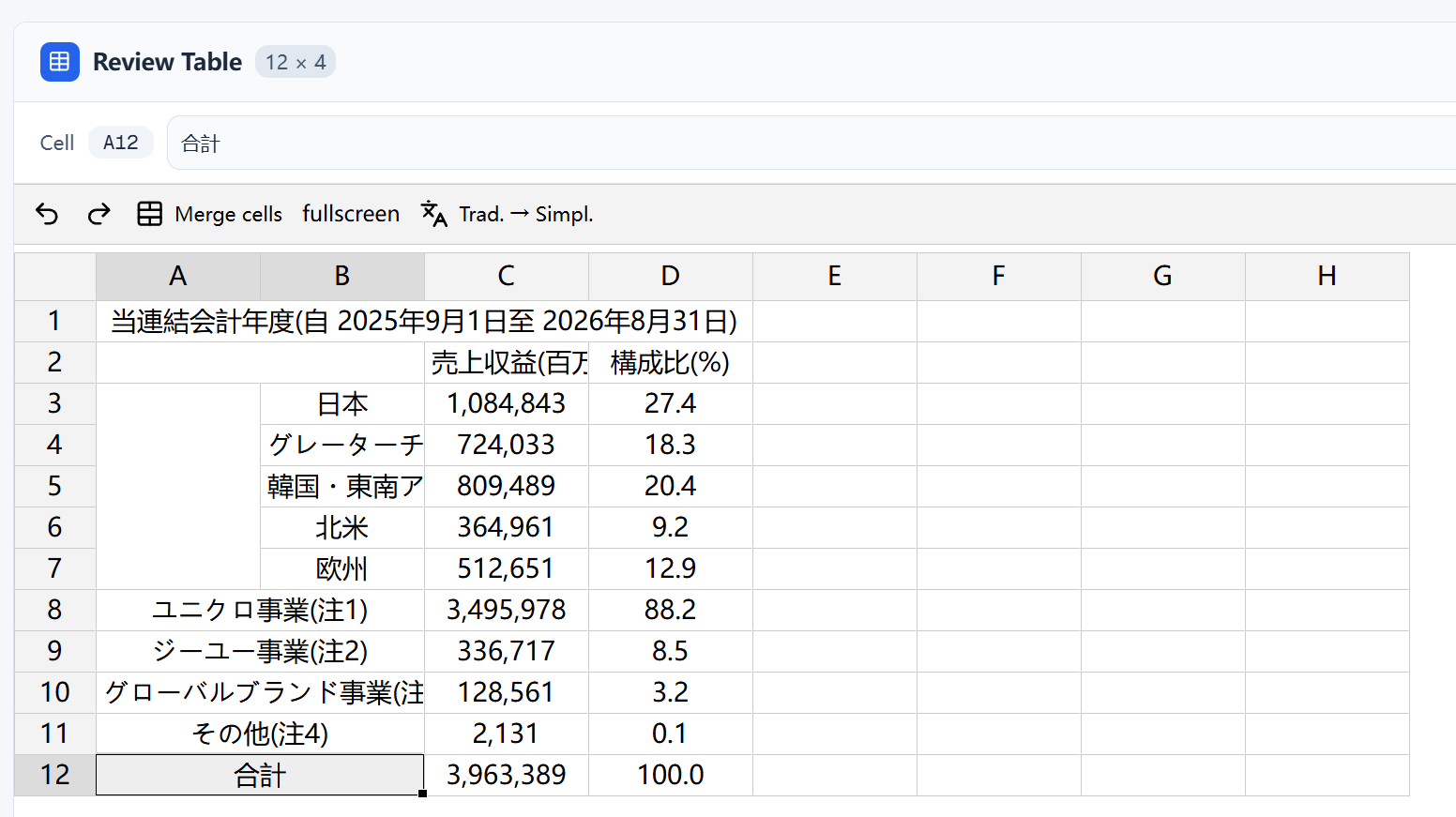
In this example, it produces a more accurate result than HunyuanOCR-1.5. Try TeleOCR for tables with unusual layouts or scans with skewed or distorted table images.